
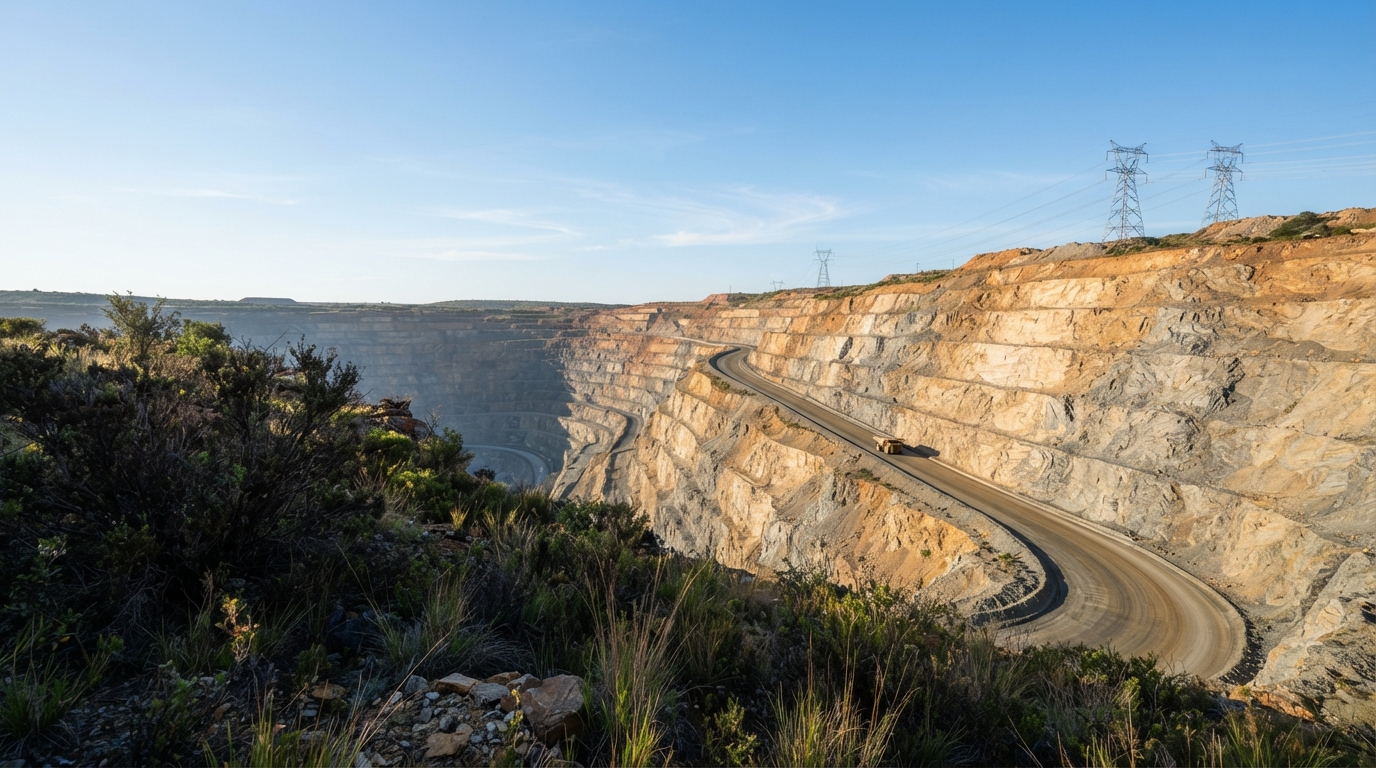
Mining. Cut your energy cost, prove your emissions.
Your electricity account keeps climbing, your carbon budget is now mandatory, and your export customers want verified data. Measure once, reduce what you can, and prove the rest.
Three pressures, one connected problem
Your operation now faces energy cost, carbon compliance and investor scrutiny as a single connected problem rather than three separate ones. The link between them is data: what you can measure determines what you can reduce, what you owe and what you can defend.
Energy is a structural cost, not a line item to trim
Deep-level and processing operations draw power continuously, and Eskom tariff increases land directly on cost per tonne. Grid constraint adds a second problem, because an operation that stops is not just spending more, it is producing less.
Carbon budgets are mandatory
From January 2026 the carbon budget allowance falls away and large emitters must comply with an allocated budget. A budget you cannot measure against is a compliance risk with a legal edge to it, not a reporting inconvenience.
The diesel fleet carries its own charge
The carbon fuel levy is 23c per litre on diesel from 1 April 2026, applied independently of your reported emissions. On a large haul fleet that is a cost that grows with production.
Fugitive and process emissions are the hardest to quantify
Fugitive methane from coal operations and process emissions from smelting and calcining sit in scope 1, are difficult to measure well, and are exactly where an estimated figure becomes expensive under assessment.


Your European customer now wants verified data
The EU Carbon Border Adjustment Mechanism entered its definitive phase on 1 January 2026. The obligation sits with the EU importer, who must now buy and surrender certificates for the embedded carbon in covered goods, including iron and steel, aluminium, cement, fertilisers, electricity and hydrogen, along with selected precursors.
The consequence for you is indirect but real. Your European customer needs verified embedded emissions data for what you sell them. Where you cannot supply it, default values apply, and defaults are set conservatively. That makes an unverified footprint a commercial disadvantage at the border rather than only a reporting gap.
Verified emissions data at product level is the answer, which is a measurement problem before it is a trade problem. See GHG emissions verification
One partner across measure, reduce and verify
Measure the position and plan the reduction
We build your GHG inventory across scope 1, 2 and 3 to a recognised standard, including the fugitive and process emissions that are hardest to quantify, then set out a costed decarbonisation roadmap sequenced by impact and payback. Where carbon credits or renewable energy certificates have a role, we advise on which instruments hold up.
See carbon accounting and GHG inventory→Cut the load and secure supply
Solar PV and battery storage, funded from the savings through a financing partner or delivered as a conventional engineering project, plus efficiency work on the systems that draw the most: ventilation, compressed air, pumping and refrigeration. Lower consumption reduces the bill and the taxable emissions base at the same time.
See solar services→Prove it to the people who will check
Independent GHG verification across all three scopes, Section 12L measurement and verification on efficiency savings, and performance monitoring on installed systems. Delta Carbon is accredited as a Validation and Verification Body and SANAS-accredited for Section 12L M&V.
See GHG emissions verification→Three disciplines, one contract, which means nobody is managing the gaps between an energy consultant, an EPC contractor and a separate verifier.
Start with the number everything else rests on
A consultation establishes where your operation stands on carbon budget compliance, energy cost and export data, and what the work to close each gap would involve. If you are carrying a carbon budget you cannot yet measure against, that is the right place to start.